Empowering Young DIabetes Warriors:
A Comprehensive Care Ecosystem
Our innovative ecosystem provides a holistic solution for managing Type 1 diabetes in school-aged children. By integrating a user-friendly insulin app, a smart insulin tracker, and a customized emergency kit, we aim to alleviate the stress and burdens faced by parents and caregivers.
Our solution offers a comprehensive approach to diabetes management, empowering young patients to take control of their health and thrive.

Chronic Care
Type 1 Diabetes at School
dabi
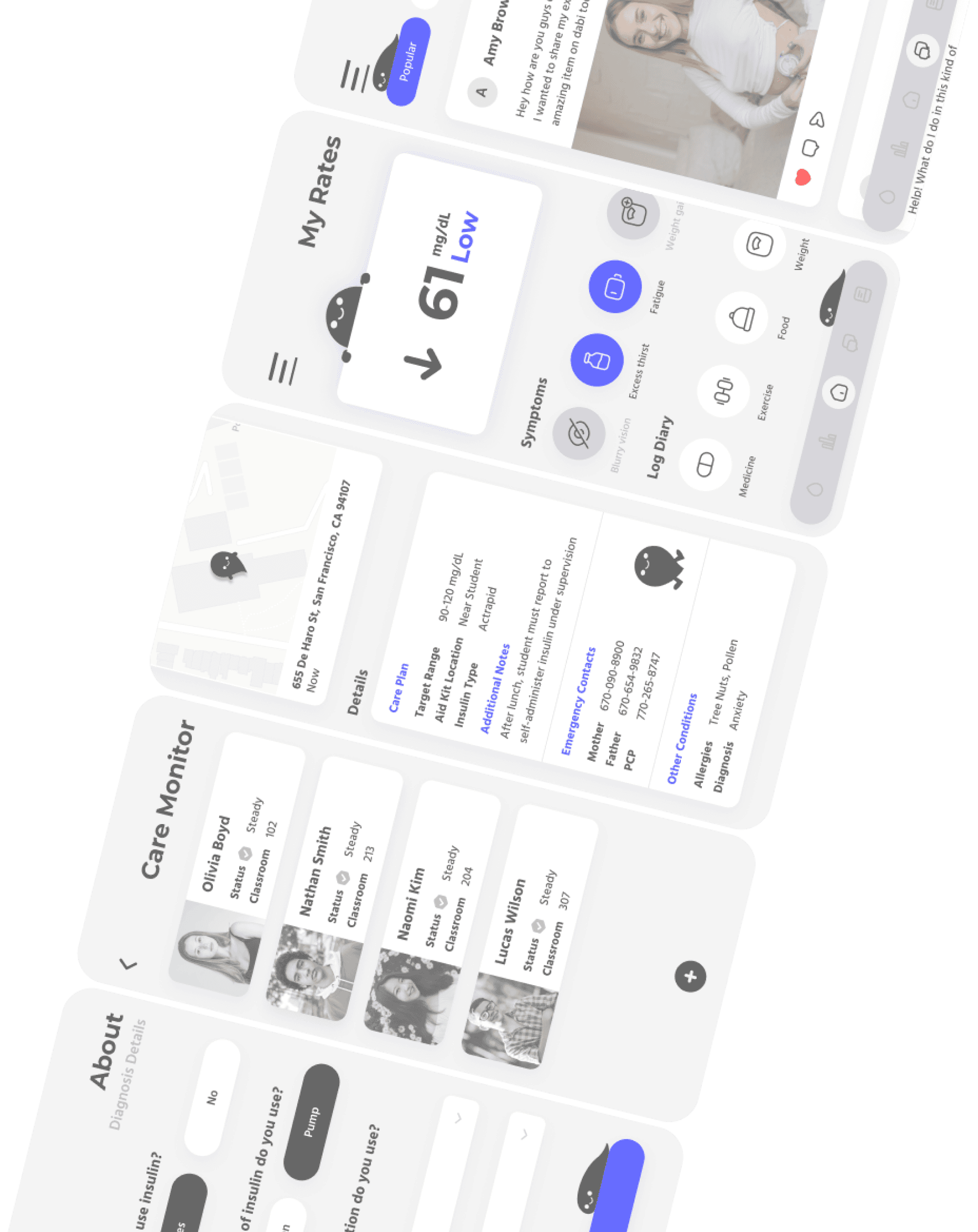

How can technology assist in managing
home healthcare for chromic disease?

Research & Analysis
Our team thoroughly researched the needs of school-aged children with Type 1 Diabetes. Through interviews, journey mapping, and treatment analysis, we identified their unique challenges and milestones.
The Statistics
In 2019, of the 283,000 children and adolescents younger than 20 with diagnosed diabetes 244,000 had type 1 diabetes.
Type 1 Diabetes is one of the most common chronic diseases of childhood in the United States, accounting for over 87% of all cases in youth ages 10-19 years.
Current School Regulations for Type 1 Diabetes
Federal law gives students the right to receive the diabetes care for safety and full participation in school. Schools must provide trained staff for monitoring glucose levels and administering insulin and glucagon.
Whether a student is allowed to self-administer is dependent upon: Approved paperwork from medical provider, parent/guardian, and school, child’s age and experience, and possibly other school specific factors.
Middle school and high school aged students: are usually able to self-manage their diabetes depending on the duration of diabetes and level of maturity but will always need help when experiencing sever hyperglycemia.
Journey Map
Diagnosis Journey
Diagnosis
Adjustment
Experiment
Routine
Being Diagnosed
Doing Research
Finding Products
that Work
Learning about Diagnosis
Experimenting with products
Being overwhelmed
Adjusting
Additional testing,
Initial instructions,
Purchasing first supplies
Dramatic lifestyle changes,
Check-ups, DSMES services,
Buying additional supplies
Trying new products, emotional
ups and downs, and increased
spending on various items.
Establishing a patient
routine, Maintaining
consistent spending.
Care at School
To School
At School
Attack
To Home
Going to School
Constantly checking blood level
Treatment & recovery
Slightly feeling symptom
Getting Attack
Routine & Home
Checking monitor status
Eating, Packing lunch
Frequent blood sugar
checks, Careful eating,
Split attention
Pre-Attack, During Attack,
Post Attack
Creating a routine,
Managing consistent spending
Personas

Jake 12
Diagnosed 2 months ago
.
Jake was recently diagnosed with Type 1 Diabetes. Jake's insulin levels are stable, and his parents handle most of his care. However, his biggest challenges are social and emotional.
.
Concerns
Social impact on his life
Lack of understanding about his disease
Feeling different from his peers

Danielle 16
Diagnosed 5 years ago
.
Danielle has been diagnosed with Type 1 diabetes for a while.Danielle is now managing her own care but is becoming more socially conscious as she spends more time with friends.
.
Concerns
Paranoia about weight fluctuations
Feeling overprotected by her family
Burnout and overwhelm from condition

Clara 40
Stay-at-home Mom
.
Clara’s 13 year old daughter was recently diagnosed with type 1 diabetes. Clara makes most decisions for her daughter’s care and is the
first point of contact during of after emergencies.
.
Concerns
Inability to monitor her daughter at school
Relying on school administrators for care
Learning to adjust to her daughter's condition

Ms.Terry 37
Middle School Nurse
.
Ms. Terry is a middle school nurse with 3 years
of experience. She manages the school care system and is looking after two middle school students with Type 1 Diabetes at her school.
.
Concerns
Monitoring students' blood glucose levels
Effectively communicating with parents
Balancing care for multiple students at once
Factors Often Overlooked
Puberty
Increases in estrogen and/or testosterone during puberty can increase blood
sugar levels and cause insulin resistance.
Menstral Cycle
Blood sugar may rise 3-5 days before periods due to hormonal changes.
Progesterone increases insulin resistance, while serotonin decline leads to sugar cravings.
Environment Waste
While unavoidable factors should be considered, we must prioritize reducing waste while maintaining or improving care quality.
How Might We…
…simplify diabetes tracking for caregivers?
….make diabetes management fun?
…create a diabetes ecosystem?

Concept Design
The Problem
Type 1 Diabetes profoundly affects children's daily lives, demanding careful attention at home and school. Existing products often do not cater to their rapid growth and developmental milestones like puberty and social awareness.
Our goal to alleviate the ongoing management stress for patients and caregivers by filling these critical gaps.
A Systematic Approach
Rather than redesigning existing monitors or insulin pump, we focused on enhancing the overall care system and communication among essential parties: nurses, parents, and patients. Our aim is to streamline and simplify this process, reducing stress and improving effciency.
Brainstorming
We designed product thumbnails to showcase various features that could help manage diabetes.

Decision Board
To organize our product ideas and identify key features, we created a decision matrix. This matrix categorized our thumbnails into physical and digital solutions.
By analyzing common themes and desired features,we identified three promising design directions. While the lower half of our thumbnails represent digital features we're already planning to incorporate, the matrix helped us pinpoint additional physical and conceptual elements to consider.

Concept 1: Alert Wristband
This wristband offers a convenient and discreet way to monitor blood glucose levels. By displaying color changes and providing gentle haptic feedback, the wristband alerts users to fluctuations in their blood sugar, reducing the need for constant monitoring.

Concept 2: Emergency Kit
This emergency kit has a compact and portable design, the kit can be easily stored at a child's desk or in the nurse's office. Equipped with an integrated pressure sensor to monitor blood sugar levels, along with other essential supplies, the kit provides a centralized location
for emergency preparedness. This ensures that diabetic children always have the necessary tools at their fingertips, promoting safety and peace of mind.

Factors Often Overlooked
Login
Tell us about the details of yourself
List you diagnosis details
How you want to manage your health
Main Page
Menstrual tracking page
CGM Tracking
Insight about CGM levels
Community for communicating
Resources about diabetes
Care Taker Page
Monitor all students at once
Track students locations
Diagnosis details, medical information
Wireframes
This wristband offers a convenient and discreet way to monitor blood glucose levels. By displaying color changes and providing gentle haptic feedback, the wristband alerts users to fluctuations in their blood sugar, reducing the need for constant monitoring.

Final Product
The Ecosystem
As stated previously, we created an ecosystem for communication between the patient; parent, and caretaker(s). This ecosystem currently consists of an app, an indicator, and an emergency kit that work in tandem with existing technologies to improve care.

The Care App
The core of our system is a multifunctional care app designed for the children, school nurse, and parent. Beyond integrating with the indicator and emergency kit, it centralizes health tracking (e.g., menstrual cycles), offers a community forum, and provides various resources.
The app adapts to the child’s growing self-care abilities, allowing for customized access to interfaces and functions based on the user’s or guardian’s discretion.

Final Product
The Ecosystem
As stated previously, we created an ecosystem for communication between the patient;
parent, and caretaker(s). This ecosystem currently consists of an app, an indicator, and
an emergency kit that work in tandem with existing technologies to improve care.
Login Interface
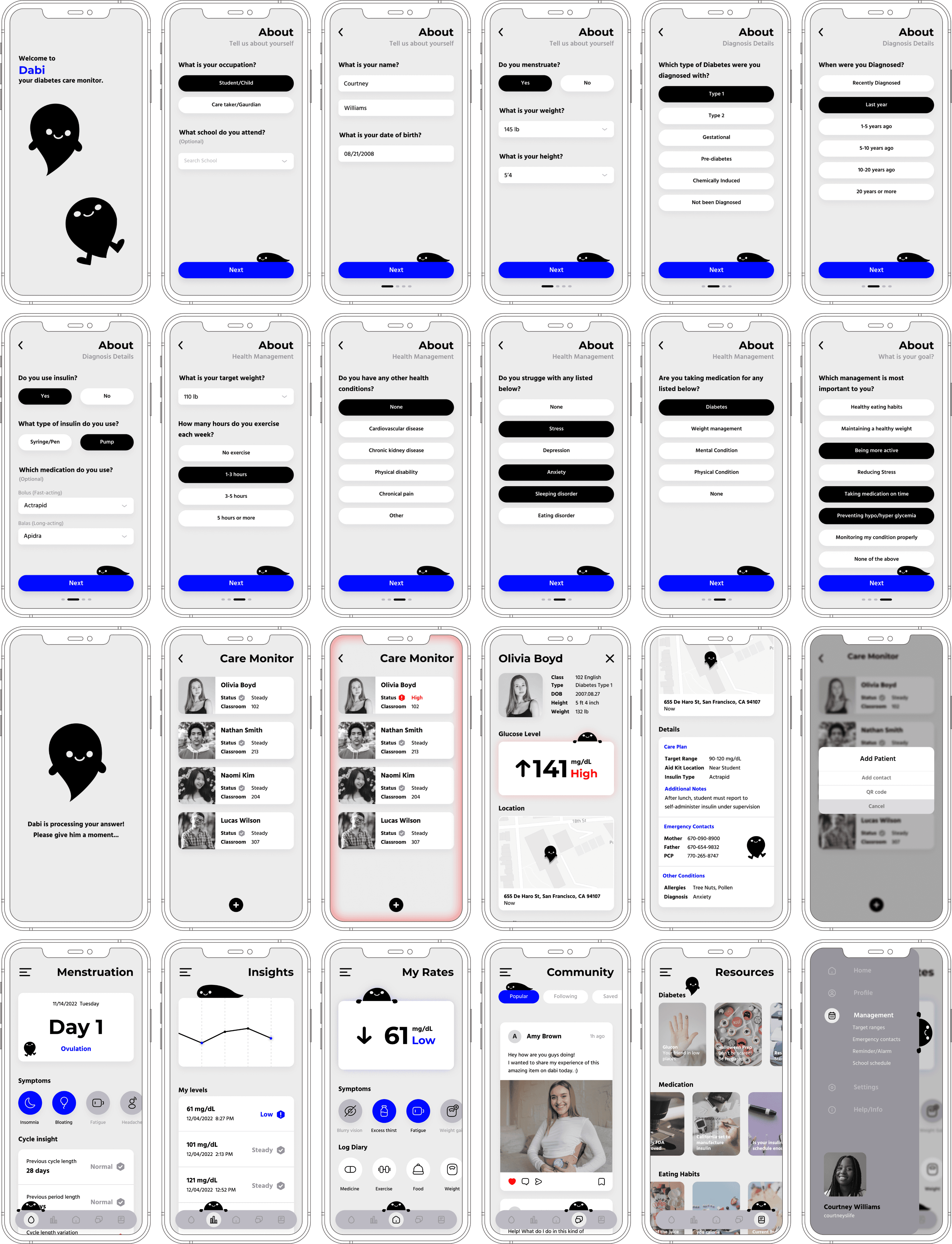
The login process focuses on four key areas to understand students’ chronic condition management: personal details, diagnosis, self-care routines, and health goals. By asking targeted questions, the AI collects essential data to customize updates to user preferences.

Student Interface
The following is the main interface for student. It contains
5 different big sections: Insight, Menstruation, Diabetes
rates, Community, Resources.
Each of the sections provide students with important
information that helps understand their chronic illness to
more in depth level.

Care Taker Interface
The nurse receives updates on a child’s glucose levels
(steady. high, or low), current class, and brief symptom
explanations if levels are abnormal. Clicking the child’s
profile provides detailed information, including CGM data,
care plans, emergency contacts, and additional conditions.

The Indicator
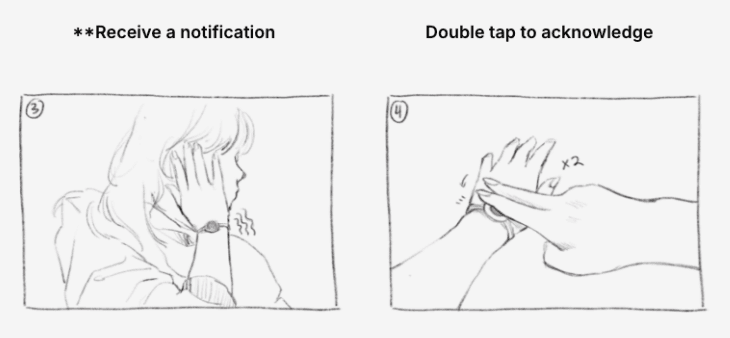
Our modular indicator, customizable or wristbands or keychains, uses color changes and haptic alerts to notify users of blood glucose fluctuations, reducing the need for constant monitoring




The Emergency Kit
Our redesigned emergency kit for diabetic children is compact and portable, perfect for keeping at a desk or in the nurse's office. It uses integrated pressure sensors to track the presence of essential supplies.



To Reiterate
The purpose of this system is not to replace what already exists, but to expedite and increase the connections between devices and stakeholders.
CARE APP
INDICATOR
EMERGENCY KIT
GLUCOSE
MONITOR

All Screens
Reflection
With additional time, I would have prioritized user testing to gather valuable feedback
and refine the emergency kit's interface, focusing on the connection with the digital
device. Additionally, I would have explored developing age-appropriate interfaces to
cater to the evolving needs of children at different stages. This would have allowed
me to tailor the product experience to specific age groups and preferences, ensuring
optimal usability and engagement.
Empowering Young Diabetes Warriors:
A Comprehensive Care Ecosystem
Our innovative ecosystem provides a holistic solution for managing Type 1 diabetes in school-aged children. By integrating a user-friendly insulin app, a smart insulin tracker, and a customized emergency kit, we aim to alleviate the stress and burdens faced by parents and caregivers.
Our solution offers a comprehensive approach to diabetes management, empowering young patients to take control of their health and thrive.
Chronic Care
Type 1 Diabetes at School
dabi
Chronic Care
Type 1 Diabetes at School
dabi
How can technology assist in managing
home healthcare for chromic disease?
How can technology assist in managing
home healthcare for chromic disease?
Research & Analysis
Research & Analysis
Our team thoroughly researched the needs of school-aged children with Type 1 Diabetes. Through interviews, journey mapping, and treatment analysis, we identified their unique challenges and milestones.
Our team thoroughly researched the needs of school-aged children with Type 1 Diabetes. Through interviews, journey mapping, and treatment analysis, we identified their unique challenges and milestones.
The Statistics
In 2019, of the 283,000 children and adolescents younger than 20 with diagnosed diabetes 244,000 had type 1 diabetes.
Type 1 Diabetes is one of the most common chronic diseases of childhood in the United States, accounting for over 87% of all cases in youth ages 10-19 years.
Current School Regulations for Type 1 Diabetes
Federal law gives students the right to receive the diabetes care for safety and full participation in school. Schools must provide trained staff for monitoring glucose levels and administering insulin and glucagon.
Whether a student is allowed to self-administer is dependent upon: Approved paperwork from medical provider, parent/guardian, and school, child’s age and experience, and possibly other school specific factors.
Middle school and high school aged students: are usually able to self-manage their diabetes depending on the duration of diabetes and level of maturity but will always need help when experiencing sever hyperglycemia.
Journey Map
Diagnosis Journey
Diagnosis Journey
Diagnosis
Diagnosis
Adjustment
Adjustment
Experiment
Experiment
Routine
Routine
Being Diagnosed
Being Diagnosed
Doing Research
Doing Research
Finding Products
that Work
Finding Products
that Work
Learning about Diagnosis
Learning about Diagnosis
Experimenting with products
Experimenting with products
Being overwhelmed
Being overwhelmed
Adjusting
Adjusting
Additional testing,
Initial instructions,
Purchasing first supplies
Additional testing,
Initial instructions,
Purchasing first supplies
Dramatic lifestyle changes,
Check-ups, DSMES services,
Buying additional supplies
Dramatic lifestyle changes,
Check-ups, DSMES services,
Buying additional supplies
Trying new products, emotional
ups and downs, and increased
spending on various items.
Trying new products, emotional
ups and downs, and increased
spending on various items.
Establishing a patient
routine, Maintaining
consistent spending.
Establishing a patient
routine, Maintaining
consistent spending.
Care at School
Care at School
To School
To School
At School
At School
Attack
Attack
To Home
To Home
Going to School
Going to School
Constantly checking blood level
Constantly checking blood level
Treatment & recovery
Treatment & recovery
Slightly feeling symptom
Slightly feeling symptom
Getting Attack
Getting Attack
Routine & Home
Routine & Home
Checking monitor status
Eating, Packing lunch
Checking monitor status
Eating, Packing lunch
Frequent blood sugar
checks, Careful eating,
Split attention
Frequent blood sugar
checks, Careful eating,
Split attention
Pre-Attack, During Attack,
Post Attack
Pre-Attack, During Attack,
Post Attack
Creating a routine,
Managing consistent spending
Creating a routine,
Managing consistent spending
Personas
Jake 12
Jake 12
Diagnosed 2 months ago
Diagnosed 2 months ago
.
.
Jake was recently diagnosed with Type 1 Diabetes. Jake's insulin levels are stable, and his parents handle most of his care. However, his biggest challenges are social and emotional.
Jake was recently diagnosed with Type 1 Diabetes. Jake's insulin levels are stable, and his parents handle most of his care. However, his biggest challenges are social and emotional.
.
.
Concerns
Concerns
Social impact on his life
Lack of understanding about his disease
Feeling different from his peers
Social impact on his life
Lack of understanding about his disease
Feeling different from his peers
Danielle 16
Danielle 16
Diagnosed 5 years ago
Diagnosed 5 years ago
.
.
Danielle has been diagnosed with Type 1 diabetes for a while.Danielle is now managing her own care but is becoming more socially conscious as she spends more time with friends.
Danielle has been diagnosed with Type 1 diabetes for a while.Danielle is now managing her own care but is becoming more socially conscious as she spends more time with friends.
.
.
Concerns
Concerns
Paranoia about weight fluctuations
Feeling overprotected by her family
Burnout and overwhelm from condition
Paranoia about weight fluctuations
Feeling overprotected by her family
Burnout and overwhelm from condition
Clara 40
Clara 40
Stay-at-home Mom
Stay-at-home Mom
.
.
Clara’s 13 year old daughter was recently diagnosed with type 1 diabetes. Clara makes most decisions for her daughter’s care and is the
first point of contact during of after emergencies.
Clara’s 13 year old daughter was recently diagnosed with type 1 diabetes. Clara makes most decisions for her daughter’s care and is the
first point of contact during of after emergencies.
.
.
Concerns
Concerns
Inability to monitor her daughter at school
Relying on school administrators for care
Learning to adjust to her daughter's condition
Inability to monitor her daughter at school
Relying on school administrators for care
Learning to adjust to her daughter's condition
Ms.Terry 37
Ms.Terry 37
Middle School Nurse
Middle School Nurse
.
.
Ms. Terry is a middle school nurse with 3 years
of experience. She manages the school care system and is looking after two middle school students with Type 1 Diabetes at her school.
Ms. Terry is a middle school nurse with 3 years
of experience. She manages the school care system and is looking after two middle school students with Type 1 Diabetes at her school.
.
.
Concerns
Concerns
Monitoring students' blood glucose levels
Effectively communicating with parents
Balancing care for multiple students at once
Monitoring students' blood glucose levels
Effectively communicating with parents
Balancing care for multiple students at once
Factors Often Overlooked
Puberty
Increases in estrogen and/or testosterone during puberty can increase blood
sugar levels and cause insulin resistance.
Menstral Cycle
Blood sugar may rise 3-5 days before periods due to hormonal changes.
Progesterone increases insulin resistance, while serotonin decline leads to sugar cravings.
Environment Waste
While unavoidable factors should be considered, we must prioritize reducing waste while maintaining or improving care quality.
How Might We…
How Might We…
…simplify diabetes tracking for caregivers?
….make diabetes management fun?
…create a diabetes ecosystem?
Concept Design
The Problem
Type 1 Diabetes profoundly affects children's daily lives, demanding careful attention at home and school. Existing products often do not cater to their rapid growth and developmental milestones like puberty and social awareness.
Our goal to alleviate the ongoing management stress for patients and caregivers by filling these critical gaps.
A Systematic Approach
Rather than redesigning existing monitors or insulin pump, we focused on enhancing the overall care system and communication among essential parties: nurses, parents, and patients. Our aim is to streamline and simplify this process, reducing stress and improving effciency.
Brainstorming
We designed product thumbnails to showcase various features that could help manage diabetes.
Decision Board
To organize our product ideas and identify key features, we created a decision matrix. This matrix categorized our thumbnails into physical and digital solutions.
By analyzing common themes and desired features,we identified three promising design directions. While the lower half of our thumbnails represent digital features we're already planning to incorporate, the matrix helped us pinpoint additional physical and conceptual elements to consider.
Concept 1: Alert Wristband
This wristband offers a convenient and discreet way to monitor blood glucose levels. By displaying color changes and providing gentle haptic feedback, the wristband alerts users to fluctuations in their blood sugar, reducing the need for constant monitoring.
Concept 2: Emergency Kit
This emergency kit has a compact and portable design, the kit can be easily stored at a child's desk or in the nurse's office. Equipped with an integrated pressure sensor to monitor blood sugar levels, along with other essential supplies, the kit provides a centralized location
for emergency preparedness. This ensures that diabetic children always have the necessary tools at their fingertips, promoting safety and peace of mind.
App Concept
Login
Tell us about the details of yourself
List you diagnosis details
How you want to manage your health
Main Page
Menstrual tracking page
CGM Tracking
Insight about CGM levels
Community for communicating
Resources about diabetes
Care Taker Page
Monitor all students at once
Track students locations
Diagnosis details, medical information
Wireframes
This wristband offers a convenient and discreet way to monitor blood glucose levels. By displaying color changes and providing gentle haptic feedback, the wristband alerts users to fluctuations in their blood sugar, reducing the need for constant monitoring.
Final Product
The Ecosystem
As stated previously, we created an ecosystem for communication between the patient;
parent, and caretaker(s). This ecosystem currently consists of an app, an indicator, and
an emergency kit that work in tandem with existing technologies to improve care.
As stated previously, we created an ecosystem for communication between the patient; parent, and caretaker(s). This ecosystem currently consists of an app, an indicator, and an emergency kit that work in tandem with existing technologies to improve care.
The Care App
The core of our system is a multifunctional care app designed for the children, school nurse, and parent. Beyond integrating with the indicator and emergency kit, it centralizes health tracking (e.g., menstrual cycles), offers a community forum, and provides various resources.
The app adapts to the child’s growing self-care abilities, allowing for customized access to interfaces and functions based on the user’s or guardian’s discretion.
Final Product
The Ecosystem
As stated previously, we created an ecosystem for communication between the patient;
parent, and caretaker(s). This ecosystem currently consists of an app, an indicator, and
an emergency kit that work in tandem with existing technologies to improve care.
Login Interface
The login process focuses on four key areas to understand students’ chronic condition management: personal details, diagnosis, self-care routines, and health goals. By asking targeted questions, the AI collects essential data to customize updates to user preferences.
Student Interface
The following is the main interface for student. It contains
5 different big sections: Insight, Menstruation, Diabetes
rates, Community, Resources.
The following is the main interface for student. It contains 5 different big sections: Insight, Menstruation, Diabetes rates, Community, Resources.
Each of the sections provide students with important
information that helps understand their chronic illness to
more in depth level.
Each of the sections provide students with important information that helps understand their chronic illness to more in depth level.
Care Taker Interface
The nurse receives updates on a child’s glucose levels
(steady. high, or low), current class, and brief symptom
explanations if levels are abnormal. Clicking the child’s
profile provides detailed information, including CGM data,
care plans, emergency contacts, and additional conditions.
The nurse receives updates on a child’s glucose levels (steady. high, or low), current class, and brief symptom explanations i levels are abnormal. Clicking the child’s profile provides detailed information, including CGM data, care plans, emergency contacts, and additional conditions.
The Indicator
Our modular indicator, customizable or wristbands or keychains, uses color changes and haptic alerts to notify users of blood glucose fluctuations, reducing the need for constant monitoring

Set up default color on app
Set up default color on app
Put on indicator (wearable)
Put on indicator (wearable)
**Receive a notification
**Receive a notification
Double tap to acknowledge
Double tap to acknowledge
*Treatment mode*
*Treatment mode*
Receive Treatment
Receive Treatment
Triple tap to finalize treatment
Triple tap to finalize treatment
Return to normal activities
Return to normal activities
The Emergency Kit
Our redesigned emergency kit for diabetic children is compact and portable, perfect for keeping at a desk or in the nurse's office. It uses integrated pressure sensors to track the presence of essential supplies.


Low blood sugar alert!
Low blood sugar alert!
Go to nurse to treat, and candy from kit
Go to nurse to treat, and candy from kit
Caretaker(s) alerted about kit usage emptiness
Caretaker(s) alerted about kit usage emptiness
Refill as needed
Refill as needed
To Reiterate
The purpose of this system is not to replace what already exists, but to expedite and increase the connections between devices and stakeholders.
CARE APP
CARE APP
INDICATOR
INDICATOR
EMERGENCY KIT
EMERGENCY KIT
GLUCOSE
MONITOR
GLUCOSE
MONITOR
All Screens
Reflection
With additional time, I would have prioritized user testing to gather valuable feedback
and refine the emergency kit's interface, focusing on the connection with the digital
device. Additionally, I would have explored developing age-appropriate interfaces to
cater to the evolving needs of children at different stages. This would have allowed
me to tailor the product experience to specific age groups and preferences, ensuring
optimal usability and engagement.